Functional Analysis and tissue-specific expression of calcitonin and CGRP with RAMP-modulated receptors CTR and CLR in chickens
Apr 2, 2024·,,,,,,
Tianjiao Huang
Jiancheng Su
Xinglong Wang
Ningkun Shi
Xiao Zhang
Jiliang He
Juan Li
Jiannan Zhang
Corresponding author
,Yajun Wang
Corresponding author
Abstract
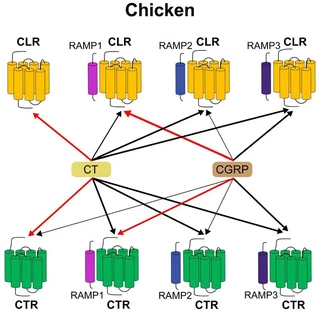
The calcitonin (CT) family of peptides, including CT and calcitonin gene-related peptide (CGRP), play crucial roles in calcium homeostasis and energy metabolism. In this study, we investigated the tissue expression profiles of these peptides and their receptors, calcitonin receptor (CTR), and calcitonin receptor-like receptor (CLR), along with their receptor activity-modifying proteins (RAMPs) in chickens. Our results showed that ‘CT was highly expressed in the ultimobranchial gland, while CGRP was predominantly expressed in the proventriculus. CTR was highly expressed in the kidney, and CLR was highly expressed in the liver. RAMP1, RAMP2, and RAMP3 were also expressed in various tissues. Functional analysis revealed that chicken CTR is a high-affinity receptor for salmon CT (sCT) and chicken CT (cCT), while chicken CLR, when co-expressed with RAMP1, functions as a high-affinity receptor for chicken CGRP (cCGRP). Both receptors were coupled with the Gαs/cAMP signaling pathway. Furthermore, we found that cCGRP, but not sCT or cCT, could inhibit the expression of PEPCK and G6Pase, which are involved in gluconeogenesis in chicken primary hepatocytes. These findings suggest that the CT/CTR and CGRP/CLR/RAMP1 signaling pathways may have distinct physiological functions in chickens, and CGRP may play a role in regulating glucose metabolism in the liver.
Type
Publication
Animals